I originally wrote this article about buying a house in Canada back in 2021 – right as the price of housing was picking up. I’ve kept it updated over the last few years as it caught the attention of Rob Carrick over at the Globe and Mail, as well as a few other big names. Five years after writing the initial version of this article, the value proposition on buying a house in Canada has certainly changed!
2026 Editor’s Note: I still don’t own a home, and while I’m not 100% averse to the idea of owning one day – that day is definitely not in the near future
By the end of the summer I will no longer be a homeowner.
In many countries that statement would be a simple matter of personal finance. Selling an asset, paying off a loan (mortgage) and moving on to another living space.
But not in Canada.
No, in Canada selling our house means that my wife and I are making a massive change to our identities. A core shift in our very essence.
Many would say we are taking a careless step backward on the path to living a fulfilled “real adult” life.
Several friends and family will likely believe that we are crazy for tossing away “the best investment one can ever make”.
The absolute obsession with homeownership in Canada continues to astound me. The emotional connection between Canadians and their real estate has been well documented, but that doesn’t make it any more logical! Even though my wife and I have owned a home for years, this was much less because we subscribed to the traditional “own at all costs” mentality, and more due to the fact that rural Manitoba housing vs rent decisions are quite different than most places in Canada.
We’ll certainly miss some of the small luxuries (goodbye big garage) of our old home, but here’s some of the reasons why we believe selling our house will be a weight off of our shoulders.
1) Endless Fear of Hearing a Strange Noise
Is that the furnace taking its last breath?
Perhaps it’s the water treatment system deciding to spring a leak?
Is that rain I hear – is it possible our septic system is backing up?!
My dad loves fixing stuff. His day is not complete until he has improved the physical world around him.
I am not my dad.
My lack of handyman skills has now become a joke that I’m comfortable laughing at, but for years I was incredibly self-conscious about possessing nearly zero masculinity-affirming fix-it ability. You want someone to work hard doing menial chores such as cutting lawns, raking leaves, shovelling snow, or lifting heavy things from Point A to Point B – I got you covered.
Anything that requires technical skills or mechanical problem-solving ability… not so much.
Because my father’s handyman-dominant brain was not passed down to his oldest son, I lived in perpetual fear of things breaking when I owned a home. I never really got this “pride of ownership” thing. For me it was definitely more of a “fear of ownership”. I had so much of my net worth tied up in this one asset – that required constant maintenance – and I really had no idea what it was doing. “Learning by doing” constantly scared me as errors were quite costly.
Hiring any specialized help on something like an air conditioning unit always seemed to cost triple what was estimated, so that just exponentially added to my anxiety levels around maintenance.
Renting = not my problem!!!
2) Is Renting Still a Better Financial Decision Than Buying in 2026?
Back in 2021 I wrote that it was “quantifiably true” that renting was better than buying. In fact, I went on to say:
I know… that’s a big statement.
It’s probably worth an article all on its own.
It will probably lead to crazy comments (as all real estate articles in Canada do) – Editor’s Note: It did!
Then I went to point out the following sources:
i) Preet Banerjee compares renting a house and renting a mortgage and then explains why he is a renter.
ii) John Robertson (my vote for most underrated personal finance philosopher) tells you why he is a renter and presents the best rent vs buy calculator that I’ve ever seen.
iii) Here’s Ben Felix’s 5% rule in action. I personally believe that Ben is shooting a bit high on real estate estimates (today’s giant houses are not comparable to historical returns data he quotes), and a bit low on property taxes + maintenance costs. He also isn’t factoring in closing costs (which are a pretty big deal when you move the number of times the average Canadian does), nor the difference between renters insurance and home insurance.
I do like his methodology, but the 5% rule of thumb for non-recoverable costs is pretty badly slanted towards real estate due to the factors mentioned above. I could probably live with a 6% rule – (speaking as a soon-to-be former homeowner of ten years).
Editor’s Note: Ben has done a ton of work in the rent-vs-buy realm since 2021. I still think he’s underestimating maintenance costs, as inflation rates on tradespeople over the last 10 years are really high even relative to overall inflation. His most recent deep dive shows that renting still wins out the majority of the time (even during a massive boom for housing in Canada vs the Great Recession in stocks in 2008).
iv) I’ve talked to many real estate experts who claim “the 1%” rule of thumb is a great filter for a potential landlord looking to add a revenue-generating property to their real estate portfolio. That means that if you can’t get at least 1% of your purchase price in monthly rent, then it’s not really worth considering the property.
The flip side of that is that if you’re renting for substantially less than 1% of the purchase price of a comparable home – then you’re getting a good deal. Bryce over at Millennial Revolution explains his rule of 150 which comes to similar conclusions.
Those are all great looks at accurately comparing financial costs vs benefits of purchasing a house to live in.
2026 Update: I continue to think these are great rules of thumb for comparing renting and buying. So let’s take a look at how these rules would guide us as we look at rent and buying across Canada in 2026.
Toronto Real Estate
The average price of a property sold in the GTA in March of 2026 was $1,017,796. Interestingly, that’s actually slightly less than when we looked at this in 2021 ($1,108,453) while the average rent is closer to $2,250 (up slightly from $2,100 in 2021). Before we crunch the numbers, it’s interesting to note that both purchase price and rent have went up at a rate less than general inflation since 2021!
- Our 1% rule landlord of thumb says that a $1,050,000 house better get you $10,500 per month in rent – or it’s not a good buy.
- Using John’s or Preet’s calculators we see that renting is WAY ahead given these parameters.
- My modified Ben Felix 6% rule tells us that if we can rent for $5,250 or less – then it’s a pretty good deal to rent. If we stick to his original 5% rule, we need to rent for less than $4,375 to be a good deal.
- Bryce’s preferred rule of 150 means that the $2,250 rental average, would dictate a mortgage payment of $1,500 as a good measuring stick for if they should buy.
Conclusion: By any measure… It’s still a better deal to rent in Toronto, even though the price of homes hasn’t gone anywhere in 4 years!
Buying a House in Calgary
Back in 2021, Calgary was still recovering from the oil shock. These days, we see that rents and property values have increased substantially.
The average rent in Calgary is roughly $1,700 (compared to $1,200 back in 2021) and the average cost of a property has gone from $510,000 to about $616,000.
- Our 1% rule of thumb says that a $616,000 house better get you $6,160 per month in rent – or it’s not a good buy.
- Using John’s or Preet’s calculators we see that renting is substantially ahead given these parameters.
- My modified Ben Felix 6% rule tells us that if we can rent for $3,080 or less – then it’s a pretty good deal to rent. If we stick to his original 5% rule, we need to rent for less than $2,567 to be a good deal.
- Bryce’s preferred rule of 150 means that the $1,700 rental average, would dictate a mortgage payment of $1,133 as a good measuring stick for if they should buy or not. A $1,133 mortgage would correlate to a purchase price of roughly $250,000.
Even with rental prices going up at a much faster rate than home prices, it’s still a good deal to rent in Calgary!
Home Prices in Halifax
Back in 2021 I decided to throw Halifax into the mix as a substantially different housing market than the big cities like Toronto and Calgary.
In 2026 the average rent in Halifax is about $1,900 per month (versus $1,600 back in 2021) and the average cost of property has risen from $465,000 to about $560,000. (Just a note, these are weighted averages taken from across all home types.)
- Our 1% rule of thumb says that a $560,000 house better get you $5,600 per month in rent – or it’s not a good buy.
- Using John’s or Preet’s calculators we see that renting is substantially ahead given these parameters.
- My modified Ben Felix 6% rule tells us that if we can rent for $2,800 or less – then it’s a pretty good deal to rent. If we stick to his original 5% rule, we need to rent for less than $2,333 to be a good deal.
- Bryce’s preferred rule of 150 means that the $1,900 rental average, would dictate a mortgage payment of $1,267 as a good measuring stick for if they should buy or not. A $1,267 mortgage would correlate to a purchase price of under $300,000.
Canada-Wide Context
Back in 2021 I wrote:
If you’re still not convinced, here are a few more stats for you.
- Canada’s current price-to-rent levels are 574% higher than they were in 1970.
- Since 1970, Canada’s price-to-rent level has risen at roughly 21x as quickly as the USA’s.
- Canada’s current price-to-rent levels are substantially higher now than the USA’s was before their 2008/09 housing crash.
In 2026, I’d add to this:
- Our current price-to-rent levels aren’t much changed in 2025, and are still WAY higher than in 1970 (we’re now at about 587% versus 1970).
- Since 2021, the US market has cooled slightly more than the Canadian market has, thus exacerbating that comparison point.
- Rent dynamics are flipping as supply catches up. After rents jumped 6.3% in 2023 and 7.9% in 2024, vacancy rose from 1.5% (2023) to ~2.3% (2024). Rents have now declined in Canada for 18 consecutive months according to Rentals.ca. Result: asking-rent growth is easing, especially in older stock.
- Population policy is easing some demand pressure. Ottawa lowered permanent-resident targets and, for the first time, set caps on temporary residents (aiming to reduce the temp-resident share toward 5% of the population). CMHC explicitly baked in “weakening migration” into its 2025 call for higher rental vacancies.
Clearly, while the numbers have changed slightly, there aren’t really any new conclusions to draw from the rent vs buy math alone.
3) Opportunity Cost of Being Rooted Into Place
I grew up in a single house – owned by a homeowner. (My parents were unique in that my dad built his own house on a very cheap piece of rural land and never took out a mortgage. Feel free to try and copy that strategy in 2021.)
It was really nice. I get that there can be some very pleasant reasons to own the house/condo that you live in.
But let’s be honest about the big picture here – there are some large trade offs involved.
Buying a home makes you much less likely to move in order to accept a promotion or career opportunity. That’s impossible to quantify, but it’s a really significant consideration.
One of the quickest ways to climb in any industry (or even make an advantageous jump to a new industry) is to be willing to move to where the opportunity is. The cost to your career of feeling as if you are anchored to the house you worked so hard to get into could be massive!
4) Our Brains Work Differently When We Think About Renting a Place to Live vs “Buying a Forever Home” – Lifestyle Inflation is Almost Inevitable.
Funny things begin to happen as we approach the leap from renter to homeowner. Suddenly, cost-benefit calculations we were doing about third bedrooms or fancy kitchens fly out the window… only the best will do for our “forever home” after all.
Weird mantras like, “We’ll grow into it,” begin to creep into our heads and suddenly we’re looking at fancy countertops, upgrading bathrooms, etc.
I’m not sure whether to blame HGTV and the homeshopping shows or what it is, but there is no doubt that most of us look at properties completely differently whether we are renting or buying. Keeping up with the Joneses becomes so much more important (is this what “being a real adult” is truly all about?) when you’re buying and furnishing a house.
One thing that we have learned from moving overseas is that we can be 98% as satisfied in a two-bedroom apartment as we were in our large bungalow. Now, I hear you that things might be different if you have a young family. I’m sure this equation changes substantially when adding children to the picture, but when you look at the smaller average house size that the larger families of yesteryear were raised in, it raises some interesting questions about how much room we all need to be happy.
5) “Drive Until You Qualify” = Too Much Driving
I have consistently found that we underestimate the cost of driving – in both lifestyle and dollars!
There have been many studies done on how spending time in the car can really impact your physical health in a myriad of ways. It doesn’t take a genius to figure out that the more time you spend sitting by yourself (often stuck in frustrating traffic) the less healthy and happy you are likely to be.
Maybe this work-from-home thing is going to reduce these financial and physical costs… but I have my doubts as to how many people this will actually affect a few months from now.
When calculating how much your commute will cost you, one needs to factor in depreciation and repairs, in addition to the price of gasoline (or perhaps electricity) and possibly parking. The government of Canada believes it costs about $0.73 per km to drive, while CAA posts similar estimates (and that’s prices from before the recent surge in Canadian gas prices).
At 260 work days per calendar year, every km you move further from your workplace will cost you about $380 per year! If you have two working adults that are both commuting in your household, it doesn’t take long for those numbers to really add up.
6) My House is Definitely NOT the Best Investment I’ve Ever Made
If the real estate boosters didn’t try to burn down this website after reading the rent vs own comparison earlier in this article, they will surely reconsider after reading this.
If I’ve heard it once, I’ve heard it two hundred times: “My house is the best investment I’ve ever made.”
While I have written extensively on this topic (and had to explain the point to many parents in the course of teaching personal finance over the years) there is simply no debating the following considerations about owning your home from an investment perspective. Note: We’re not talking about owning a rental property here – that’s a much different conversation.
- There are many reasons why the Holy Grail of investment advice is Thou Shalt Diversify. Tying up all of your cash (and then borrowing huge amounts of money that tie up all future earnings) is NOT diversification. Having your entire net worth determined by one building in one location is not a smart risk management decision.
- Why is it that when people borrow money to invest in the stock market (known as leverage) it’s considered inherently risky, but when people borrow 9x their downpayment on a house it’s considered “common sense”?
- When we think about how much money we’ve “made” on our home, we often forget to include all of the non-recoverable costs involved such as taxes, maintenance and repair costs, transaction fees to buy & sell, renovations that cost way more than they added resale value, etc.
- The Case-Shiller Housing Index has stated that between 1928 and 2013, the average annualized rate of return for American housing was 3.7%. The average annual rate of return for American stocks was 9.5% during that time period. Canadian housing and stocks track much the same path.
- The National Association of Home Builders in the USA has stated that the average home in 1950 was 983 square feet, and by 2015 it had nearly tripled in size to 2,740 square feet! When you adjust for this fact, the actual increase in value per-square-foot of house is much smaller than the 3-4% number that is commonly tossed around in both Canada and the USA. Likely more in the 1.5-2% territory.
- If you think that the last few decades have been the “golden age of Canadian real estate” then you might be surprised to find out that since 1982, Canada’s house prices have only gone up an average of 1.7% per year (vs an average inflation rate of 2.46%).
- Even in super-hot real estate markets like Vancouver over the last couple of decades, stocks have still done better than real estate by a considerable margin.
- House values do NOT always go up – no matter what your friend in Toronto says. Go back and ask a Floridian in 2008 or a Calgarian in 2014.
Remember, these considerations are looking backwards at record return decades for Canadian real estate. We are now likely close to the top of that mountain (if not at the peak), so going forward…
Alternative investments to Canadian real estate:
View our guide about Canada’s best dividend stocks if you want to learn more about beginner-friendly ways of investing your money into safe non-real-estate assets.
7) Freedom to Travel… Forever
Ok, so this one is likely somewhat unique to us.
I get that not everyone wants to spend years travelling without a fixed address.
That said, I think most Canadians would be amazed at how cheap it is to travel months on end if they don’t have to pay a mortgage back home, and don’t have to fly during the peak weeks of the year. I know that my wife and I were astounded when we went down the digital rabbit hole and found out just how many people were “slow travelling” 12-months per year for under $25,000 CAD.
I don’t think we’re quite as frugal as many of these veteran travellers, but after some pretty extensive research and many conversations with people actually living the “digital nomad” or “FIRE” lifestyle, we think we could pretty easily mix 6 months in relatively expensive countries like Canada, the USA, Western Europe, etc, with 6 months in cheaper countries centred on Eastern Europe and SE Asia, for $40,000 CAD.
2025 Update: My wife and I actually did this last year. We spent 3 months at our family cabin in rural Ontario, then went to Portugal for three months, Thailand for two months, Bali for a month and Japan for a month.
All-in, the price tag came in around $45,000. That includes many flights, an excellent cheap ticket on a Japanese cruise sale, several 3-to-5-day stays at luxury resorts, and several months in good-to-great Airbnbs. Financially, it was a success. It was a bit lonelier than we anticipated at times – but that’s not the math’s fault!
Beyond the obvious fun of seeing more of the world, we love the idea that we will get to spend more time with friends and family that don’t live close to where our 9-to-5 jobs were in rural Manitoba.
AirBnb and competing rental platforms have really changed the game when it comes to attempting to live this “no fixed address” lifestyle. With monthly discounts and competition keeping prices low, finding a place to live for 1-3 months has never been so convenient or affordable. If you want to be responsible for someone’s pets, there are even more affordable travel opportunities available!
Canadian Housing Prices in 2026 (How Expensive is Canada Really?)
After we wrote about gas prices in Canada a couple of weeks ago, I thought it might be useful to take a look at housing affordability in Canada for 2026.
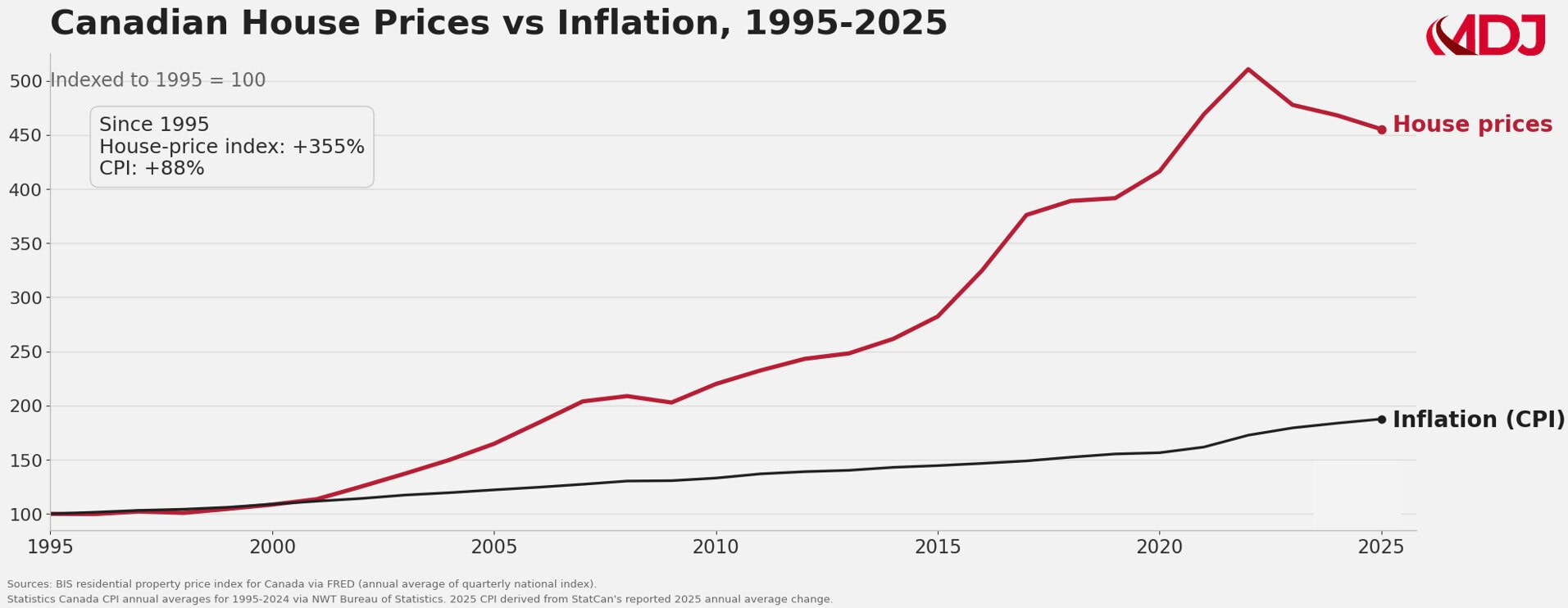
If you’re wondering just how expensive housing has gotten in Canada over time, you can take a look at the inflation-adjusted Canadian house prices charts below. The first one I put together to show just how much faster Canadian housing has went up relative to the average overall inflation (and don’t forget that housing is actually a pretty big part of the overall CPI basket as well, so that means that the gap between housing and “everything else” is actually larger than what you can see here.
Then, I wanted folks to be able to see in real dollar terms just how expensive housing has gotten in Canada and why some folks call it a housing affordability crisis.
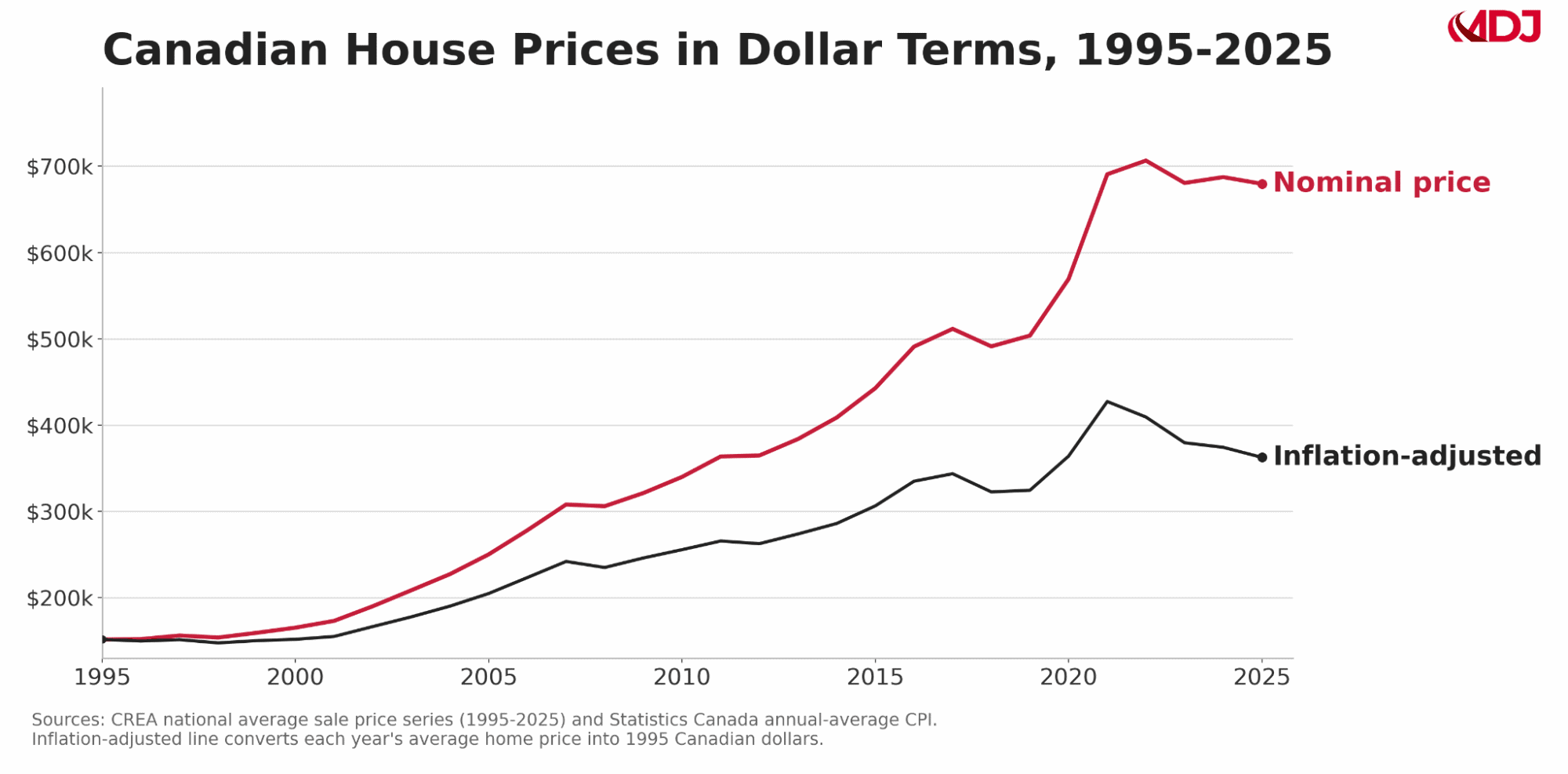
It’s pretty clear to see that the cost of living in the Canadian housing category has went up significantly in the last 20 years.
It’s also interesting to note that while Canadian real estate gurus like to say, “Oh the market is just taking a bit of a breather until it goes up again – it has hardly gone down at all.”
…That’s not exactly true in real-life.
Because inflation has been somewhat high the last few years, we see that in inflation-adjusted terms, Canadian housing has actually lost a substantial amount of value. When you compare that to the massive stock market returns of the last five years, I’d say my 2021 housing sentiment holds up pretty well!
The good news is that housing affordability in Canada has improved slightly in the last few years. The bad news is that the overall cost of living for the housing category is still way higher than it was even 20 years ago.
Canada Cost of Living: Housing Costs
I still think a lot of Canadians underestimate where their total housing costs come from. I have yet to meet a homeowner of more than a few years (who didn’t buy new) who thinks they only spend 1% in maintenance. I also think that we look at our mortgage payment and we don’t totally mentally calculate how much of that is interest.
Let’s take a quick look at a plausible home ownership case. Helen the Homeowner decides that she’s ready to take the plunge and buys a $700k house in a small Ontario city.
She has diligently saved up the 70K that she needs (making good use of her FHSA and RRSP). With 10% Helen is going to need a mortgage for nearly $650k because as a high-ratio insured mortgage, she is going to owe some extra. Here’s a rough idea of what her total housing cost of living will be over the next 25 years if she averages a 4.3% mortgage interest rate (pretty generous by historical standards). I’m keeping everything in 2026 dollars here for ease of comparison.
- Down payment: $70,000
- Home principal repaid: $630,000
- Mortgage interest: $407,403
- CMHC insurance premium: $19,530
- Ontario tax on CMHC premium: $1,562
- Property tax: $131,250
- Home insurance: $37,500
- Maintenance: $262,500
- Ontario land transfer tax: $10,475
Total 25-year out-of-pocket cost: about $1,570,220
So for the first 25 years of home ownership, that works out to the following breakdown:
- Home principal repaid: 40.1%
- Mortgage interest: 26.0%
- Maintenance: 16.7%
- Property tax: 8.4%
- Down payment: 4.5%
- Home insurance: 2.4%
- CMHC premium: 1.2%
- Land transfer tax: 0.7%
- Tax on CMHC premium: 0.1%
It’s interesting to note that the actual price of the home is significantly less than half of the total housing cost of living.
It’s OK to Own a Home – and It’s OK NOT to Own One Too!
It’s odd to say, but that makes it no less true: Owning your home in Canada is an emotional decision heavily tied to middle-class identity.
Because the decision is so important, no one likes to think that they chose the “wrong” path. Consequently, there are very few rational conversations to be had when it comes to home ownership. Like most issues that cut to the core of our identity, we usually choose our side, and then selectively look for arguments or data to support the decision we made.
I’ve been on both sides of the home ownership debate and the only thing that I can decisively say is that for some people owning a home makes sense – but for many others it simply does not.
Hey, if you are 80%+ sure that you’re going to be rooted in the same area for 10+ years, and you derive a lot of enjoyment out of handyperson fixes/renos, then the benefits of home ownership might make it the perfect choice for you.
That said, judging by all the “buy at all costs” talk I continue to hear from coast-to-coast, I think we really need to examine the bigger picture when it comes to home ownership.
2026 Update: Very little has changed since 2021 that has led me to change my thinking on rent vs buy. You can see in the comments below that it hit a major pain point for a lot of folks (as I predicted it would). While rent and housing prices remain fairly stagnant in most markets since 2021 (and have actually decreased relative to general inflation).
At the end of 2020, the S&P 500 was at USD$3,756 and the TSX 60 was at CAD$1,034. As of writing this update they are at $7,126 and $1,996 respectively. Good for a stock market gain of 90% and 93% respectively. Once you factor in that the S&P 500 would have spun off a dividend of a little less than 2%, and the TSX 60 would have rewarded you with 3%, the case for stocks gets even stronger.
Now, who knows, the next five years could look much different, but I’m going to take a victory lap on this controversial article for the time being!