While we on Million Dollar Journey generally recommend straightforward investments like Canadian dividend stocks and index investing using Canadian ETFs, there is a growing curiosity from certain investors (commonly, HNWI) who seek out a more active management style of management. We have covered a variety of alternative investing vehicles, and the case for buying strategic, rare earth, and industrial metals is one of the more fascinating ones out there.
When volatility is high and there are extraordinary geopolitical conditions, like today, investing in rare earth elements or strategic metals in industries like defence, telecom, and solar, can prove to be beneficial and even surpass other traditional methods of investing.
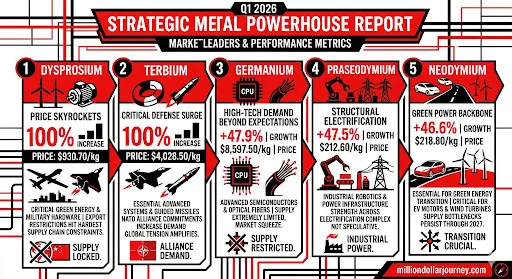
But as great as the reward is, so is the risk; if you do want to invest, do so responsibly while looking at the broader portfolio and materializing the fact it’s an investment that may go fully sour. All you need is prices to inch back to 2024’s prices and there goes 70% of your metal portfolio.
If you seek to truly invest in the value of strategic and rare metals, you could buy ETFs for copper, aluminum, and zinc but you could not gain direct exposure to rare earth metals or strategic in-demand metals like Indium, Iridium, Gallium, Germanium or Rhenium. There are quite a few miners in the various metal spaces but if you buy their stock, you are essentially investing in their performance and only indirectly in the mined material’s price.
To buy rare and strategic metals, you would have to physically purchase it from a supplier. The good news is that you won’t have to deal with storage, handling, finding a buyer, dealing with VAT or any of those “metal supplier” things.
You would only have to pay, get a receipt of payment, and communicate with your Sales Rep if you want to make additional purchases, or sell some or all of your materials. It will cost you 1% + VAT to use their storage services which also include full insurance. The supplier is appropriately regulated with a history of 35 years in business and massive trading volume, dealing with Fortune500 companies for the most part.
I’m not advocating that these types of speculative investments should be a majority (or even a large chunk) of your portfolio. But with traditional stock and bond markets growing increasingly correlated to one another, owning raw amounts of incredibly-useful commodities is one of the few ways to truly diversify your overall exposure.
Million Dollar Journey readers can view current prices on EarthRarest.com and buy those metals (a package or any specific metal like Gallium, Germanium, Indium, Dysprosium, Terbium or even silver) starting from $50,000 through this form. The Earth Rarest will facilitate the logistics of the purchase of your physical metal from the B2B supplier I mentioned above.
Please note, this is an alternative investment which is:
- Unregulated – there aren’t many people worldwide that buy those metals for investing purposes, 99.99% of global trade is between large manufacturers.
- Meant for those with a large portfolio who are looking to diversify.
- Volatile – the prices of these metals can easily go up 100% in any given year, or drop by 50%.
High Risk Investment
We wrote about investing in gold before, as gold investing positions itself as one of the most popular ways to invest in Canada, and concluded that in the long term, the stock market outperforms it in a big way. With that being said, gold can be counter-inflationary, and many followers of the “Permanent Portfolio theory” believe that it’s not a bad idea to invest a small portion of your portfolio into it.
Investing in rare earth metals and strategic technology metals serves the same purpose as gold investing. This type of unique diversification even makes more sense nowadays considering the complex geopolitics and microchip boom, propelled by Trump’s $500bn AI infrastructure investment and China’s export ban of such strategic metals.
But, and this is a pretty big but, the sort of investors who should even be considering that are those with large portfolios who want to dabble in yet another alternative investment, not people looking to make a big, expensive bet in a space that very few can predict and that still depends heavily on China’s willingness to release materials into the market (more on that below).
What Are Rare Earth Metals?
Rare earths are not actually that “rare”, per se. In fact, they are fairly abundant in the Earth’s crust. But, and that’s a big but, they are centered in a few specific locations, and extraction is extremely difficult and costly, and hence the volumes available each year are miniscule (whereas demand is on a constant growth trajectory).
For investors, the part that really matters is that this family of 17 elements is essential for the creation of strong permanent magnets and many other hard-to-replace bits of modern hardware.
What Are Strategic Metals?
“Strategic metals” is the looser label, and honestly the more useful one as far as investors are concerned. This is where gallium, germanium, indium, hafnium, tantalum, and beryllium live – these are the metals sit inside chips, displays, fiber optics, jet-engine parts, and power electronics, usually in tiny amounts, and due to their unique chemical markups, they are utterly and completely irreplaceable. Their supply chains are also highly concentrated – similar to rare earths.
Demand For Rare Earth and Strategic Metals
The demand is the more interesting part of the equation. IEA says rare-earth demand rare-earth demand was 91 kilotonnes in 2024 and is expected to reach 123 KT in 2030. This is after multiple years of 6-8% annual growth. The reason is simple. EVs, storage, renewables, electricity grids, jet engines and microprocessors all use the same metal basket.
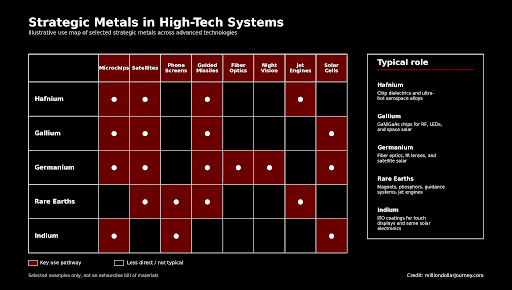
Here is a lowdown of rare and strategic metals and their usage across multiple industries:
Smartphones: Depend on several technology metals. Indium and Gallium are key ingredients in touchscreens, providing the clarity and responsiveness that consumers expect. Meanwhile, Germanium is essential for optical systems and high-speed integrated circuits. The smartphone industry giants like Apple, Samsung, and Huawei are always pushing for thinner, more powerful, devices and they do so through usage of these strategic metals.
Microchip Manufacturers: Rely on these materials to create faster and smaller semiconductors. Intel, TSMC, and Samsung invest billions of dollars in research each year in research to improve chip performance, with a huge reliance on Gallium Arsenide (GaAs) and Indium Phosphide (InP) for superior electron mobility and efficiency.
Aerospace and Defense Companies: Heavily consume certain strategic metals. Hafnium and Tantalum, for instance, are crucial for a plane’s heat resistance and strength, making them indispensable for jet engines and military hardware. Companies like Boeing, Lockheed Martin, and Rolls-Royce require these metals to produce cutting-edge aircraft and defense systems that can withstand extreme conditions.
There are no substitutes for rare earth metals in this field, as the aircraft would become far less durable if they were to use other elements instead. That is a major selling point in today’s world which seems to put more and more resources into defense technology.
Geopolitics and Price Impact
One of the most compelling factors driving the surge in demand for both rare earth and strategic technology metals is the fact that China – which has consistently held the lion’s share of refining capacity for metals like hafnium, gallium, and germanium – recently imposed an export ban on several of these elements.
That move is triggering what could possibly be a major disruption for American and other Western tech manufacturers. It also artificially keeps demand high as China is flexing their muscle as a semi-monopoly in the space – thus raising the price for everyone.
While this will limit supply, President Trump’s record-breaking $500 billion AI infrastructure investment, topped by tens of billions to be invested by Microsoft, Amazon, and Google into such infrastructures, will increase the demand for such metals.
Companies like Intel, Qualcomm, and Apple are already scrambling to secure reliable stockpiles, while defense contractors like Lockheed Martin and Raytheon are looking to diversify their supply to ensure continuity of production lines.
Any gap in the availability of hafnium, gallium or germanium, for instance, could disrupt the manufacturing of high-speed chips and cutting-edge sensors. Shortage in Terbium, which is currently ongoing, is putting a dent on the production of phone screens. Dysprosium, which is also in shortage, is a must-have in production of high power magnets and EVs.
Moreover, Trump’s election has reignited the strategic emphasis on “Made in America” and the drive for self-reliance in key sectors. The administration’s repeated references to national security threats has led federal agencies and the private sector to ramp up spending on everything from raw rare earth ores to refined strategic metals. But it may take years until the US is able to produce those elements at a quantity that is a match to their grandiose plans.
Trump even announced Project Vault which entails $1 Billion in investment in these very metals as a strategic defense stockpile.
Another major consideration is the impact of the Middle East wars which are putting a strain on the logistics of moving metals around the world, and causing the sort of instability that pushes large companies to stock up rare metals. The key idea here is supply chain resiliency and it is quickly overtaking the old-school conventional wisdom of the “Just In Time” model that capitalized on maximal global suppliers to cut costs to the bone.
Investing in Rare Metals
If you read to this point, then you probably understand the thesis behind investing in rare earth elements, or strategic metals. But surely, you still have some concerns about investing into a physical asset stored thousands of miles away from you.
Frankly, if there was a stock or Canadian ETF that properly tracked an index of these rare earth metals – and conveniently traded on the Toronto Stock Exchange, I would have been all for that. Unfortunately, there is nothing like that on the market today. For a metal like Uranium, for instance, you have the Sprott Physical Uranium Trust Fund (U-U.TO) which does a decent job in tracking the underlying price, but for Gallium, Germanium, Indium, Dysprosium and the likes, there’s nothing out there.
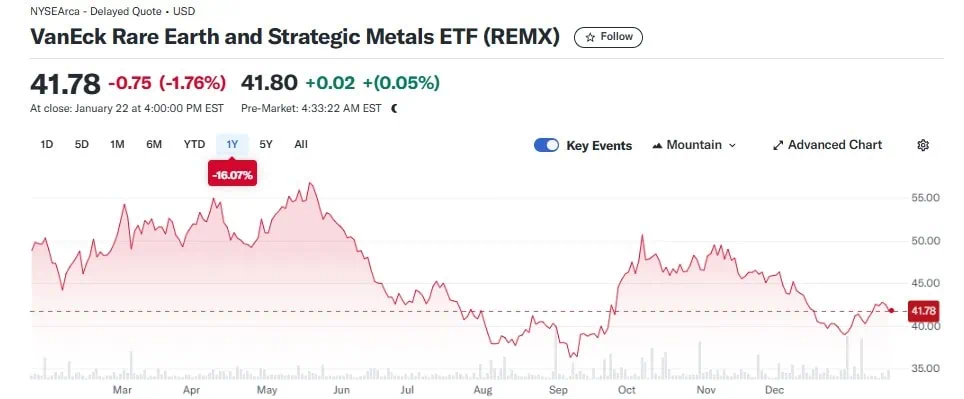
The most popular option out there is probably the VanEck Rare Earth and Strategic Metals ETF (REMX) which has a somewhat high expense ratio of 0.83% – but just consistently delivers poor returns:
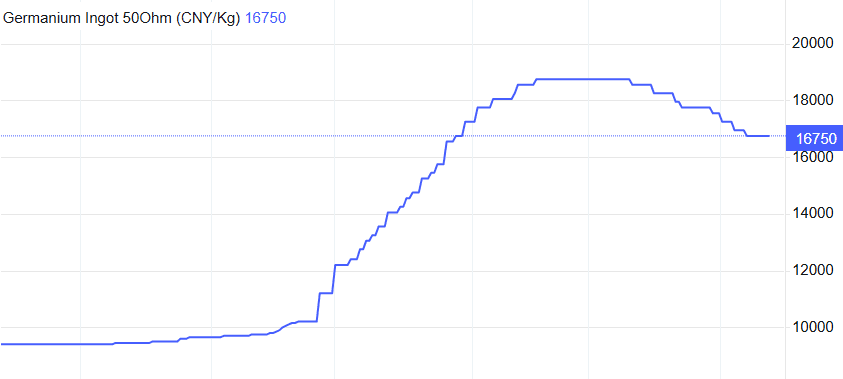
Over the same period, this is how the sport price for Germanium moved:
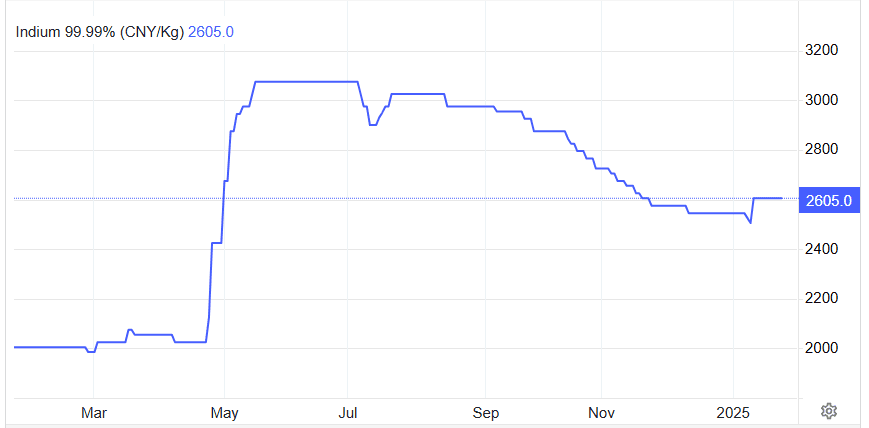
This is Indium:
By investing into the physical asset you get
- To decide which metals you want to invest into.
- To actually track the exact performance of the market price.
- To physically own these metals. Stock market meltdown, financial systems collapse etc., wouldn’t make the slightest difference to your investment.
- Truly diversify from having all your assets locked in your brokerage account.
- Become a frontrunner in investing, delving into a form of investment that very few have access to (but requires a min investment of $10,000).
How it Works
As odd (or different) as the process of buying rare earth and strategic metals seem, it’s actually pretty straightforward and safe.
After booking a sales call, you get a callback from a Sales Representative of Earth Rarest, a metal broker. Then and there you will get a complete lowdown of the process, the associated costs, what kind of assurance you will get, how to visit the physical storage facility etc.
The Sales Rep will explain more about Tradium, which is the company that facilitates those investments. Tradium is a family-owned company with more than 25 years of experience in metal trading geared at industry b2b import and export. Private investors make up a small part of their thriving business. They buy and sell in the hundreds of millions of dollars each year, store more than 300 tons of strategic metals in storage, and supply some of the world’s biggest names.
If you decide to invest, you will get a sales invoice to pay facilitated directly by Tradium, as well as a separate storage agreement. After paying you will get a confirmation about your purchase, storage, insurance policies, and how to schedule a visit. You will also get reassurance that Tradium is able to liquidate your position without a hassle on an almost immediate notice. That feeling of immediate liquidity goes a long way to allaying any fears investors have about investing in such a non traditional manner.
Again, it’s worth reiterating here that the average person looking to invest a few thousand bucks each year in their RRSP and TFSA isn’t the target market for this sort of investment. This is for folks who are really more into the wealth management stage of life, or looking to diversify from traditional investments big time like investing in collectibles, and believe they can identify an imbalance in the market.
Personally, I think there is a much better supply-and-demand rationale for buying rare earth metals than for joining the herd and buying a gold ETF. As far as commodity investments go, I think the investment thesis for select strategic metals is much better than for almost any commodity out there.