Transitioning from the accumulation stage of my professional career, to withdrawing investments in early retirement was harder than I expected. For those who haven’t been following me since I started writing Million Dollar Journey back in 2005, for decades, my focus was simple: earn income, save aggressively, and steadily build my investment portfolio. That’s the phase most personal finance articles focus on.
I used MDJ to slowly-but-surely detail my rise from a very average net worth, to building an investment portfolio that has allowed me to reach financial independence at a much younger age than most Canadians.
Here are some of the key articles that I’ve written along the way (and plan to keep updated throughout 2026)..
But as I’ve now shifted to the decumulation stage of my family’s personal finance journey, my focus has obviously had to change. I thought it was worth it not only to go through my early retirement withdrawal plan for multiple investment accounts, but to keep it updated over the years in order to ensure I stay on track.
My fellow MDJ writer Kyle Prevost has written an excellent piece on how to save taxes and optimize withdrawals from an RRSP and TFSA. In addition to those account withdrawals, one has to consider their CPP, and OAS, to make sure they squeeze the most juice they can out of those fruits of their labour. I personally haven’t yet reached the age where those decisions are paramount, but the timing of when to access those plans does actually affect my spending decisions today!
The final question for my wife and I revolves not only around how to most efficiently withdraw from our retirement investment accounts, but also to leave something to the estate. Warren Buffett kind of sums up our approach by saying, “You should leave your children enough so they can do anything, but not enough so they can do nothing.” For others, they want to die with $0 in their bank accounts – to each their own!
Are You Saving Enough for Retirement?
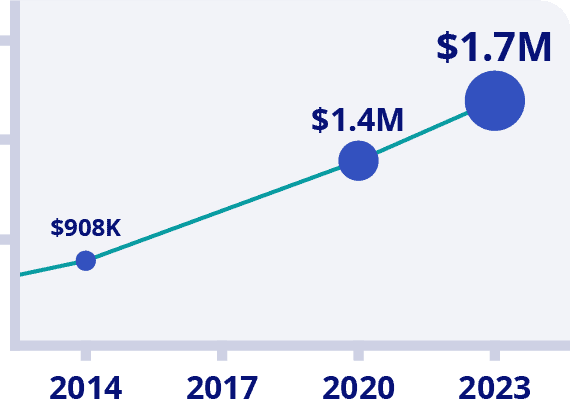
Canadians Believe They Need a $1.7 Million Nest Egg to Retire
Is Your Retirement On Track?
Become your own financial planner with the first ever online retirement course created exclusively for Canadians.
Get $50 Discount With Promo Code MDJ50
*100% Money Back Guarantee
*Data Source: BMO Retirement Survey
Our Investment Accounts
As discussed in our financial freedom updates, we have the following accounts:
- RRSP x 2
- TFSA x 2
- Non-registered accounts x 2
- Corporate investment account x 1
- Small defined benefit pension accessible at age 60
My MDJ co-pilot Kyle Prevost actually created a course specifically looking at DIY Canadian retirement planning that looks extensively at this exact question. You can read my personal full review of his course (called 4 Steps to a Worry-Free Retirement) by clicking here.
When it comes to this sort of advanced planning we have to keep in mind that there are several variables involved, and that there are levels of optimization. It may very well be the case that for some people, getting the low-hanging fruit taken care of – and then stepping back to enjoy life – is the better route than optimizing every single penny of retirement planning. That’s perfectly fine.
Some General Rules of Thumb for Retirement Account Withdrawals
Keep tax-sheltered accounts funded for as long as possible, but watch out for the old age security (OAS) clawback which is about $95,000 for 2026. After that income, OAS will be reduced by 15% for every dollar until it’s eliminated at when you have about 155,000 in taxable income. (These clawback thresholds now increase when you turn 75.) Consequently, in a perfect world, you want to keep your retirement income under $95,000 (per spouse). See our Ultimate OAS guide for more details.
If you have a spouse and want to truly cut tax bills to the bone, one preferred scenario is to keep both incomes just under the first tax bracket. In Ontario that would be about $50,000, and in Nova Scotia that would be about $31,000. The first federal tax bracket tops out at about $58,000 (and in 2026 the tax rate dropped from 15% to 14%). Having a tax-efficient family income of $100k would make for a comfortable retirement for most families.
Withdrawing from RRSPs early sometimes makes sense. Even though the accepted rule of thumb is to keep the RRSP as long as possible (up until Dec 31 on the year you turn 71 when you are forced to convert to an RRIF), there are a number of situations that drawing down the RRSP early has merit. This is now commonly called “An RRSP Meltdown Strategy”.
For example, say your spouse has a large RRSP balance, has health issues, and unfortunately passes away early. In that scenario, the RRSP gets transferred to you tax-free. This is great, but when you reach 71 and are forced to convert the RRSP to an RRIF, you’ll be required to withdraw 5.4% of the account balance in the first year and increasing after that.
If you have a $1M total RRSP, that would be $54,000 in the first year of RRIF withdrawals and increasing annually. When you add CPP/OAS on top of your RRSP income, you’ll likely start seeing OAS clawback – which is essentially an additional 15% tax. Not only that, when the second spouse passes away, the large RRSP balance will likely face the highest marginal tax rate (over 50% in most provinces).
One strategy could be to retire a bit early, live on RRSP withdrawals, leave all other accounts intact to grow (or withdraw enough in addition to RRSP to fund your preferred lifestyle), all while delaying OAS/CPP for one or both spouses depending on health (up until 70). This would result in drawing down the RRSP balance to reduce forced taxable withdrawals at 71… which would hopefully be enough to mitigate OAS clawbacks.
All this while letting the TFSAs continue to compound, and getting an increased CPP/OAS payout (the longer you delay CPP/OAS, the higher the payout).
Income split as much as possible. If you have a spouse, the goal is to keep incomes as equal as possible to maximize income and minimize taxes. You’ll have to wait until you turn 65 for the RRIF withdrawals to be eligible for income splitting with a spouse for tax purposes, and to be eligible for the $2,000 pension tax credit. Defined Benefit Pensions can also be split with a spouse for tax purposes (this can be a huge advantage for families where one spouse is a government employee). Here is the MDJ list of all the ways to income split in Canada.
Finally, consider annuities. We’ve got the most comprehensive guide to Investing in Annuities in Canada of anywhere on the internet for good reason: They are an excellent way to keep life simple and to guarantee a solid (if not great) return on your investment dollars. Of course that comes with the trade-off if you were to pass away early in retirement, but if you read that article you’ll see why we think that trade-off is worth it in many cases.
Objective Financial Partners: Save Your Retirement from the Tax Man
Are you optimizing your long-term tax strategy? Get a FREE consultation with our Top Financial Planning Company
Funding Early Retirement
Keeping those rules of thumb in mind, they will apply to every one of you in a different way. To some, they will have no issues with the OAS clawback threshold, to others, especially those with full defined benefit pensions or large RRSPs/non-registered accounts, taxation can potentially be reduced with some proper planning.
Kyle wrote an excellent guide to withdrawing from your TFSA and RRSP in which he looks at how understanding the tax rates of various types of investment income is really the key to this whole thing.
But how does this apply for someone who plans on retiring early?
From our family’s perspective, my wife and I reached financial independence in our early 40’s. We tend to keep our expenses fairly low which has been between $60k – $65k per year, all while raising two kids. I like to think that we live a balanced albeit comfortable life, which may not sound possible on $65k/year, but having no debt payments makes all the difference. We also live in a low-cost part of the country (definitely not Vancouver or Toronto).
To fund early retirement, my strategy would be the following:
- Use dividends from non-registered accounts and corporate portfolio first. Using dividends would allow for tax-efficient income, especially for early retirees. This may get to be a challenge when you approach OAS time as dividends are grossed up by 38%. So if you make $40k in taxable eligible dividends, it will look like $55k for income testing against OAS. Something to be mindful of if you are approaching senior status. But being someone with 20+ years until senior status, the tax efficiency of dividends are welcome.
- Use RRSPs for luxuries. While dividends from non-registered sources are enough for our daily expenses (at the moment), I would top-up our income by drawing down the RRSPs. While it wouldn’t deplete the RRSPs, it would help keep it to a more manageable level when we reach forced RRIF withdrawals age.
- Leave TFSAs in-tact. Combining non-registered accounts and RRSPs for spending will give us a lot of flexibility with the TFSAs. We could keep the TFSAs compounding over the years OR simply spend it. It will likely be a mix of the two. This can potentially be used as a future slush fund for luxuries such as travel, vehicles (likely one vehicle household by that point), and/or to leave to the estate/charity. Thankfully, TFSA withdrawals are not income tested for seniors benefits (as of right now!).
- Delay OAS and/or CPP – With enough income to live on via dividends and drawing down on our RRSPs, we may delay OAS and/or CPP. This would depend on our health and the size of our RRSP when we reach senior status. See our CPP guide for more details on how to defer your CPP.
Further Efficiency Needed
Going through this process has made me realize that there is an RRSP imbalance between me and the boss. If we keep going on this path, this will result in lopsided RRSP withdrawal taxation up until the age of 65 where we will be able to split the withdrawals (must be converted to RRIF first).
To mitigate this, I plan on opening a spousal RRSP (likely another account with Qtrade) to help even out the account balances over the coming years. After all, the goal is to balance retirement income between spouses to minimize taxes while maximizing income.
It’s also important to keep in mind what a flexible tool the TFSA withdrawal can be in early retirement. Here’s a few things to keep in mind:
- There is no penalty for TFSA early withdrawals (in fact, there is no such thing as withdrawing from a TFSA early, because it’s not like the RRSP in this regard, you can withdraw from a TFSA at any age).
- There is no withholding tax or income tax owing on TFSA withdrawals.
- TFSA withdrawals do not affect your OAS benefits.
- TFSA withdrawals do not affect your Canadian Child Tax Credit benefits (which is important for early retirees that still have children under the age of 18).
Early Retirement Update 2026
While I wrote this article a few years ago to help me plan my early retirement, I have actually kept working (on my own terms) after achieving financial independence a few years ago. Anecdotally, I’ve found this to be the case with a lot of folks who have reached financial independence at a relatively young age. I still enjoy the daily challenge of my job, as well as working on this website when time allows.
Kyle wrote an interesting article a few months ago looking at working after retirement in Canada. I feel like a lot of the psychological and lifestyle benefits that he details in that article apply to my situation.
In terms of a generalized update – I can’t lie, life is good. When you go to a job where you have the leverage to say, “Yup, I can continue to contribute if you want me, but it’ll have to be under the following conditions…” it really has a different appeal than when you’re grinding away to build net worth week after week.
I actually haven’t had to worry about withdrawing from my RRSP yet, as my dividend income and my work income have been enough to fund my family’s lifestyle pretty comfortably. In fact, with the 2026 RRSP season in full swing here in Canada, I recently updated my $1,000,000 RRSP article for folks starting in their 30s, 40s, or 50s, so that might be worth a gander.
With the stock market having had a really great 15-year run, I think we all have to be mentally prepared for a bit of a slowdown here at some point. For investors who have had the risk-on dial turned all the way up, it might be time to take a few chips off the table. When the downturn inevitably does happen at some point, remember these good times when you saw your net worth go up massively in just a couple years. It will help you get through the negative news headlines that try to press your fear buttons.
You should have better things to do in retirement that watch the stock market numbers after all!
Oh – I also wanted to point out in this update that I’ve gotten a ton of questions in regards to RRSP withholding tax lately. It usually goes hand-in-hand with the sentiment that “RRSPs are a rip-off.”
I can’t express this strongly enough: RRSPs are definitely not a rip-off. I’ve personally realized massive benefits from RRSPs. The rip-off theory usually comes from folks not understanding the value of re-investing their RRSP tax deduction (and accompanying refund) – and dishonest marketing from insurance people trying to sell high-commission permanent insurance plans.
In regards to RRSP withholding tax. That amount you pay when (or rather, that is “withheld” from you by the financial institution that you have your RRSP with) is just like the income tax money your employer used to hold back before they paid you. The actual amount taken off the cheque during a specific pay period doesn’t really matter. You’re going to settle up with the CRA at the end of the year anyway – and if you paid a little too much, the government is going to give you your money back via a tax refund.
So don’t worry if the online broker or the bank holds back 15-30% of your RRSP cash. It will NOT change the actual amount of tax that you owe for the year anyway. Instead, you should be focusing on legal income splitting opportunities to lower your overall tax rate in retirement.
Final Thoughts
I originally wrote this early retirement post several years ago when my early retirement target was quickly approaching, but was not yet achieved. As I update it over the years to reflect my personal experiences and research, I am proud to say that I’ve actually hit the financial independence mark.
We haven’t fully embraced early retirement yet, but the option is there if we want it – and that’s a pretty cool feeling!
I’ve also enjoyed contributing to many of the “preparing for retirement” articles that we’ve written here at MDJ over the past couple of years including topics such as:
These articles (and helping Kyle create his DIY preparing for retirement course) have really smoothed out my own learning curve as far as feeling confident in my early retirement plan.
I’ll continue to update this article as I continue to transition from financial independence + working on my own terms, to early retirement. I’m curious what all of you who read MDJ would like to hear about as far as early retirement investing, or other types of preparation? Any questions or suggestions below would be welcome!
Are You Saving Enough for Retirement?
Canadians Believe They Need a $1.7 Million Nest Egg to Retire
Is Your Retirement On Track?
Become your own financial planner with the first ever online retirement course created exclusively for Canadians.
Get $50 Discount With Promo Code MDJ50
*100% Money Back Guarantee
*Data Source: BMO Retirement Survey