What is RBC Direct Investing?
The Royal Bank of Canada (RBC) was one of the first banks in the country to pioneer DIY investing for the everyday investor.
With RBC Direct Investing, you can trade Canadian and US stocks, ETFs, mutual funds and bonds. You can fund and manage your registered investment accounts (TFSA, RRSP, RRIF, RESP and more) and access a variety of investing tools to help you make informed decisions.
If you already have an account with RBC, then opening an RBC Direct Investing account might appeal to you, as it will make the process more seamless and efficient. You’ll also have the added benefit of redeeming your Avion points/rewards for money you can use to trade using your investment account.
If you’re not already an account holder, then it’s definitely worth considering other options. As far as the Big Banks go, we prefer BMO’s InvestorLine. BMO offers the same reliability you’ll find with RBC – along with $0 trading commissions on select stocks and ETFs.
You can check out our full BMO InvestorLine Review for more information about why we prefer it over RBC Direct Investing.
Is RBC Direct Investing Safe and Trusted?
RBC is the biggest company in Canada, with a banking history that stretches over 150 years. As the nation’s premier chartered bank and financial institution, it’s a name synonymous with trust, serving millions of customers globally with unwavering reliability. When we talk about trustworthiness in banking, RBC sets the gold standard.
Operating under the watchful eye of the Investment Industry Regulatory Organization of Canada (IIROC) and being a proud member of the Canadian Investor Protection Fund (CIPF), RBC Direct Investing is a fundamentally safe platform. Its digital fortifications include:
- 128-bit encryption for ironclad data protection
- Robust firewalls to guard against unauthorized access
- The option for multi-factor authentication, adding an extra layer of security
- Anti-virus protection and data verification programs to maintain the integrity of your investments
RBC Direct Investing’s dedication to online security is unparalleled, demonstrated by their promise of 100% reimbursement for losses due to unauthorized transactions—a testament to their confidence in their security measures (though, as expected, terms and conditions apply).
While any form of investment inherently carries some risk, RBC Direct Investing ensures that from a security standpoint, your ventures are as safeguarded as possible. The responsibility for investment choices remains yours, but with RBC, you’re operating within one of the safest platforms the Big Bank brokerages have to offer.
RBC Direct Investing Review: Trading Fees and Prices
When it comes to RBC Direct Investing’s fees and trading commissions, it’s important to understand that RBC (and all of Canada’s large banks, for that matter) rarely seek to be the cheapest option available.
They entice you with a great platform, the safety of being one of Canada’s most trusted companies, and the convenience of keeping all of your banking under one roof. Value isn’t one of their selling points.
While we don’t recommend choosing an online broker based solely on price, it does help to know which high-quality option saves you the most. There are a number of brokers that offer stock and ETF trading at a lower cost or even for free. Meanwhile, RBC Direct Investing charges $9.95 per trade, or $6.95 per trade if making over 150 trades per quarter.
Compare that to Qtrade or Questrade, which feature free trading of stocks and ETFs, although Questrade does have ECN fees per trade. It’s clear where you’re going to keep more of your money and add to your bottom line.
RBC Direct Investing Review: Account and Transaction Fees
While RBC has a $0 minimum deposit (which is great!), it does come with other fees you may incur. RBC Direct Investing charges a quarterly maintenance fee of $25 ($100 annually). However, you can avoid this fee if you do any one of the following:
- Are a new client (opened your account less than 6 months ago).
- Have $15,000 or more in your combined RBC Direct Investing accounts.
- Set up a minimum pre-authorized contribution plan of $100 per month or $300 per quarter.
- Pay for three trades during any quarter.
- Have an RBC student banking account (or have had one in the last five years).
- Have an RBC VIP banking package, or qualify for the RBC Direct Investing Royal Circle program (more on this later).
Below is a quick chart of the more common RBC Direct Investing transaction and account fees that you might run into.
| Fee | Amount |
| Possible Account Maintenance Fee | $100 Annually ($25 per quarter) |
| Inactivity Fee | $0 |
| Deposit Fee | $0 |
| Brokerage Account Withdrawal Fee | $0 |
| RRSP Withdrawals | $50 |
| TFSA Withdrawals | $0 |
| FHSA Withdrawals | $0 |
| Home Buyers Plan & Life Long Plan Withdrawals | $25 |
| RIF, LIF, RLIF, PRIF & LRIF Withdrawals | $0 for the first two per year, then $25 for each additional withdrawal |
| Wire Transfers (to North America) | $45 |
| Cheque Requests | $10 |
| Confirmation Replacement | $2 |
| Statement Replacement | $5 |
| Research Account Inquiries | $40 per hour (Min. $20) |
| Non-Sufficient Funds (NSF) and Returned Cheques | $45 |
| Certificate Registration | $50 |
| Transfer Out | $150 |
| Internal Transfers (third party) | $25 |
| Estate Account Processing | $175 – $350 per account |
It is worth noting that if you are an RBC account holder, you may pay lower fees, or even no fees on certain transactions that non-RBC account holders pay full price for.
RBC Direct Investing Stock Trading Fees
As we’ve said, when it comes to the RBC Direct Investing trading fees, you’re going to pay $9.95 per transaction (including ETF trades). You can trade on any North American stock market and there are no ECN fees when using RBC Direct Investing. If you’re an active trader making over 150 trades per quarter, you will only pay $6.95 per trade.
ETF Trading Fees
Unlike Questrade, Qtrade, and a few big bank brokerages like BMO InvestorLine, Scotiabank’s Scotia iTrade and National Bank of Canada, RBC Direct Investing does not offer free ETF purchases or sales. Buying an ETF is treated exactly the same way as buying a stock/share, and incurs the same hefty $9.95 price tag (or $6.95 if you’re one of the day-trader types).
| Online Discount Broker | Per Transaction Cost to Buy ETFs | Per Transaction Cost to Sell ETFs |
| RBC Direct Investing | $9.95 | $9.95 |
| Qtrade | $0 | $0 |
| Questrade | $0 | $0 |
Options Trading Fees
Options trading isn’t really my thing, but the RBC Direct Investing options trading fees follow the same philosophy as their stock trading fees. Most people are looking at $9.95 per trade + $1.25 contract fee.
Most options traders are substantially more active in their account than everyday ETF index investors, so these fees really add up in comparison to low-cost discount brokerages.
RBC Direct Investing Bond Trading Fees
When it comes to purchasing bonds, it’s not surprising that RBC Direct Investing is not the most cost-effective option. For bonds, you’ll pay commission depending on the transaction amount, which starts at $25 per transaction. (if you do it yourself online or mobile) and goes all the way up to $250 per transaction. Pricing for bonds with an RBC representative starts at $43 per transaction.
RBC Direct Investing: RBC Active Trader Program
Like many of the Big Banks, RBC Direct Investing offers active traders special discounts and extra resources. Investors who make 30 or more equity or options trades each quarter automatically qualify for the Active Trader Program.
RBC Active Trader features include:
- Level 2 quotes with detailed insights into stock prices
- Premium research from Morningstar and RBC Capital Markets
In addition, traders who make 150+ trades per quarter qualify for a special lower commission on all trades ($6.95 instead of $9.95).
These perks can make a difference to active traders—but lower cost, fully featured online brokers would help even more.
RBC Direct Investing: Royal Circle Membership
The RBC Royal Circle is RBC Direct Investing’s special offer for large accounts and/or the most active traders. To qualify, you must have a month-end balance of $250,000 or more for 4 consecutive months or accumulate over $5000 in trading commissions annually.
RBC Royal Circle Membership perks include:
- Exemption from certain fees including quarterly maintenance fees, RRSP withdrawal fees, and statement/confirmation replacement fees.
- Priority service from the most experienced representatives for the member and any other investors in their family.
- Premium research from Morningstar and RBC Capital Markets.
- Preferred margin rates for your investment borrowing needs
RBC GoSmart Commission-Free Investing
New this year is RBC’s GoSmart Commission-Free Investing. It appears the big bank is trying to put forward something more comparable to some of our favourite discount brokerages like Qtrade and Questrade. However, we’d most liken it to TD Easy Trade, which you can read more about in our TD Direct Investing Review.
According to RBC, “GoSmart is RBC Direct Investing’s mobile-first investing solution. Designed for new investors, it removes traditional barriers with no account maintenance fees, no minimum investment, and commission-free trading.”
You get 50 commission-free trades per year on Canadian and US Stocks and ETFs, but there are unlimited commission-free trades on select ETFs – those being exclusively iSHARES ETFs.
For someone starting out and wanting that sense of familiarity with their regular bank, RBC GoSmart Commission-Free Investing may be a good option. It is only available to RBC clients using the RBC Mobile app.
They are also running a promo offer: get $50 when you deposit $500 by April 2, 2027.
RBC Direct Investing Account Types: TFSA, RRSP, Non-Registered
Like all of the leading Canadian discount brokers these days, RBC Direct Investing offers all of the usual accounts including:
- Non-registered accounts (both CAD and USD)
- Margin Accounts
- RRSP (both CAD and USD)
- TFSA
- FHSA
- RESP
- RRIF
- LIF
- LIRA
Make no mistake, you may pay a bit more with the RBC online broker vs some of the lowest-cost Canadian brokerages, but you will get the platform and the account selection that go with investing through one of Canada’s largest companies. Whether that trade-off is worth it is up to you.
RBC Direct Investing Platform & Tools
RBC Direct Investing offers both a web-based and app-based platform, both of which come with solid tools and resources.
For example, users can access information from sources such as Morningstar and RBC Research through either platform. These industry-standard tools are great, but may not be of great use to less experienced investors.
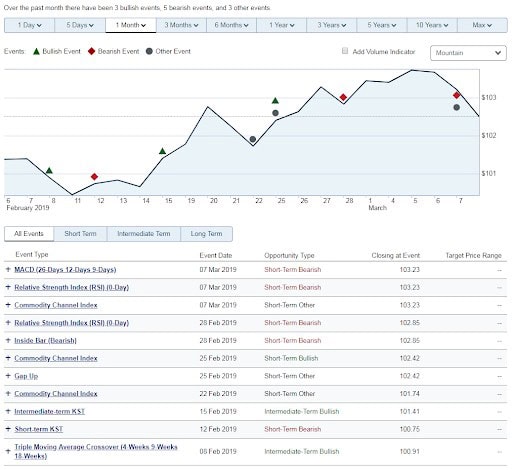
An excellent resource for RBC Direct Investors is the analyze and rebalance tool. This tool can save users the guesswork of trying to make sure they have the best balance for their investment strategy, and even give them suggestions of how to improve it if needed.
In 2018, RBC launched RBC InvestEase, a robo-advisor that compliments its banking and brokerage services, offering a cost-effective tool to its customers who want the benefits of having an advisor without the high cost. We’ve got more information for you over at our RBC InvestEase Review if you’d like to learn more about this service.
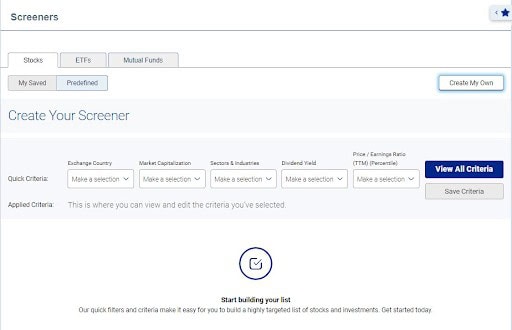
RBC Direct Investing also offers analyst-built screeners by Refinitiv, which are screening tools that can help investors find specific stocks that fit their criteria in terms of risk, industry, potential dividend earnings, and more.
RBC Direct Investing Practice Accounts
RBC Direct Investing is one of a handful of brokers that offer practice investment accounts. RBC’s practice account is integrated into the actual investing site, which means that you get a realistic trading experience with $100,000 in fictional assets.
You can “buy” and “sell” ETFs, stocks, and options, all risk free. You can also try out RBC Direct Investing’s tools and resources and track your performance over time before you invest a cent of your own money.
RBC Direct Investing practice accounts are available to all RBC clients, regardless of whether they have an investment account, which means you can give the service a real test drive before committing (and can track your fees to see how much of a difference RBC’s pricing would make for your bottom line).
Overall, RBC has made a solid attempt to keep up with industry standards when it comes to its online platform, its functions and its tools.
RBC Direct Investing Mobile App Review
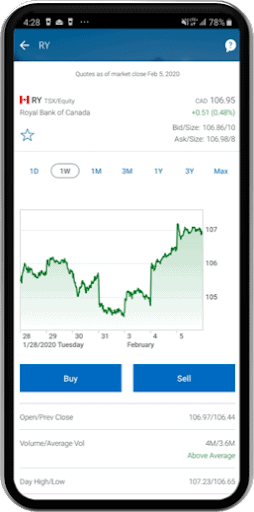
These days, most investors expect a mobile app from their online broker, and RBC Direct Investing delivers on that front. The app is available for both iOS and Android.
The RBC Mobile app has received a spectacular 47 stars from over 211,000 ratings on the Apple App store. Over on the Google Play store, its rating fares a bit lower at 3.5. It seems like newer android versions have become more buggy than previous versions. That’s definitely not something you want when your investment app updates.
Through the app, you can access all of your RBC accounts as well as use it for your investment needs. It has all of the features you would expect from a decent investing app, such as:
- Safety and security with biometric sign-in
- Easy to navigate system
- Access to market information
- Clear and simple account monitoring interface
- Fast transactions
- Tracking of your investment performance
Want to see how RBC’s mobile app measures up to the competition? Check out our full Best Stock Trading Apps Review for a list of the apps we prefer.
RBC Direct Investing Review: Customer Service
While RBC prides itself on strong customer service, we’ve received an alarming number of negative comments here on our RBC Direct Investing Review in the last few years. We understand that people who have negative experiences are more likely to tell other people about it – but still, it’s concerning.
While all of Canada’s brokerages have experienced some growing pains recently, it appears that RBC has had an especially difficult time. We’ll continue to keep tabs on this trend moving forward, but it doesn’t appear to have improved since our last update.
You can reach RBC Direct Investing customer service line from 7AM-8PM ET during the work week at 1-800-769-2560.
RBC Direct Investing vs. Qtrade
Now that you have a good idea of what RBC Direct Investing has to offer, let’s look at it in comparison to another self-directed investing option – Qtrade, our top recommended online broker. We’ve mentioned them both throughout this article, but it’s helpful to see their information side by side.
|
$100 per year (can be avoided) |
||
|
Stocks, ETFs, Mutual Funds, Options, Fixed Income Securities |
ETFs, Equities, Exchange-traded Debentures, Fixed Income, Mutual Funds, Options |
|
|
Elite, rated the best in Canada |
||
|
Above average, better than most big banks |
Elite, rated the best in Canada |
|
|
10% Cash Back + Unlimited Free Trades |
||
| ; | ; |
RBC Direct Investing Review: FAQ
Who Is RBC Direct Investing Discount Broker Best for?
When you weigh the pros and cons, choosing RBC Direct Investing is difficult to justify unless you’re already an RBC client who values having all your finances in one place. The relatively high trading commissions, combined with quarterly account fees, make it an unnecessarily pricier option than many of the alternatives.
Although it does offer protection through IIROC and CIPF, that level of coverage isn’t unique. Plenty of other Canadian online brokerages provide the same safeguards while charging less and often delivering a smoother customer experience.
For investors who appreciate strong service and the option to visit a physical branch, a Big Bank platform like BMO InvestorLine may be a better option. If you’re comfortable going fully online but still want dependable support, we recommend our top-rated online brokerage, Qtrade.