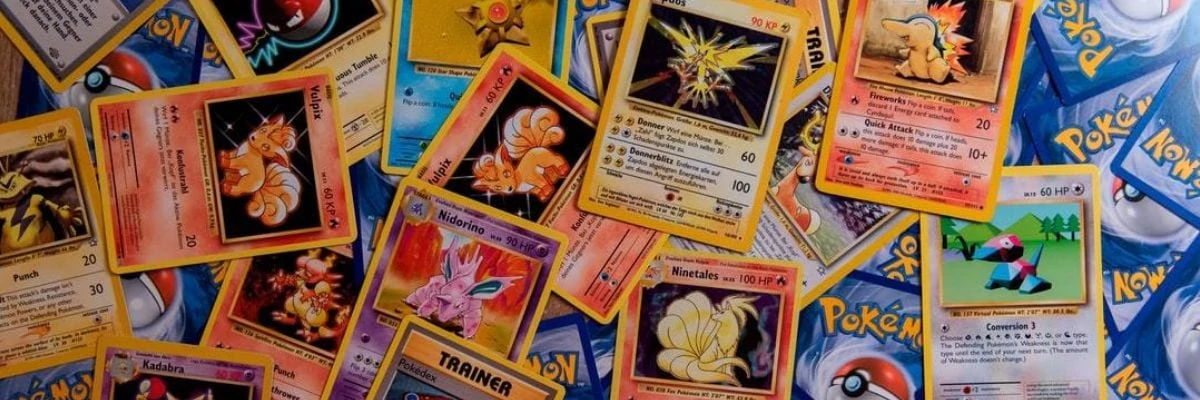
Ever since I first published this article back in 2021, a lot has happened. The collectible market has seen the post-COVID whipsaw, got a prime-time Netflix show called The Goldin Touch, and watched Shark Tank panel member Kevin O’Leary spend over $12,000,000 on a single sports card. In all fairness, some collectibles, bought at the right time, would have offered some pretty hefty returns, to say at the last.
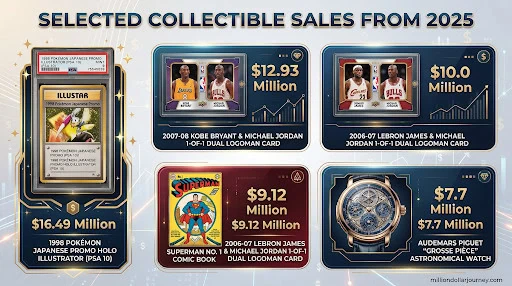
Still, it’s not all sunshine and roses with collectible investing. When you buy a collectible as an investment, you need to know what you’re buying, have a plan for how you’re going to liquidate it, be familiar with the fees and risks that come with it, and, more than anything, understand how it fits within your portfolio.
If you’re buying something because you enjoy it, or because it looks good in your man cave, you can pretty much skip this write-up. It isn’t really intended for you. This guide is for people who have built an investment strategy that includes alternative investments, and where collectibles serve a purpose in that portfolio, whether that’s growth, hedging, or short-term capitalization of trends.
In my view, there’s too much to know about collectible investing to fit into a single article. Some branches of the collectibles world are distinctly different from one another – wine and whisky are not art, Pokémon cards are not sports memorabilia, and VHS tapes are their own strange little niche as far as can be from rare earths. Each has its own dynamics, maturity, and liquidity.
That is why we created the free e-book below, where we share tips on getting more out of your collectible investing journey, avoiding common traps, and developing better investor habits within a world that can be very tempting.
Should I Invest In Collectibles?
Editor’s Note: Not all members of the MDJ editorial team advocate for investing in collectibles, this article is for informational purposes only.
To set the record straight, even if someone feels they are an expert AND that they LOVE investing in collectibles, AND they have a 7- or 8-figure portfolio, I’d still not go above 2% allocation (of the entire portfolio).
If I were a newcomer to a hobby who wanted to do a bit of investing, I’d probably go as low as 0.05% to 0.1% of a six-figure or higher portfolio. If I had less than six figures saved up, I’d skip collectible investing altogether and look into one of Canada’s best ETFs or at our list of Best Canadian Dividend Stocks. It doesn’t mean that people can’t enjoy collecting or buying themselves whichever item they desire to own, but I wouldn’t look at it as “investing”.
Collectibles shouldn’t be anyone’s bread and butter. They’re the lovely cream on top, and sometimes a bit of latte art if things go well. No more, no less. The growth potential can be high, but this is also one of those assets you do not want to be holding when the market is coming down.
Some collectibles are more liquid than others, but unlike the stock market, where billions of orders for each instrument happen all the time and help establish a “true” price through multiple deals, collectibles – especially at the high end – can have a current price based on a few last sold items, a single sale, or no sales at all.
For that reason, the dynamics and the heavy lifting required from investors are much greater and, again, you need a high degree of expertise to deal with those knowledge gaps, the illiquidity, and the lack of transparency.
That said, I don’t think putting a very low percentage of your portfolio in collectibles is a bad choice, especially if you have a favourite collectible that you can actually enjoy collecting or investing in. Honestly, collectibles make far more sense to me than Bitcoin does.
The world’s governments have every incentive to come down on cryptocurrencies one day – but people with a lot of discretionary income will always be willing to pay for “cool”, “unique” and/or nostalgic items that are simply luxury purchases that make them feel good.
It’s true that unlike company stocks, collectibles don’t have intrinsic value. They don’t generate revenues and are only driven by demand and supply, much like Canadian energy stocks. As such they are a lot more speculative than other asset classes. What happens to Mickey Mantle cards when the older generation dies? Could early sports cards have the same fate as did stamps when the snail mail died? It’s entirely possible.
That’s why if you are investing in collectibles, you should do so in moderation and ignore the false pretenses claiming these assets will appreciate in value for all eternities (the notion that Logan Paul and Gary Vaynerchuk are trying to establish). Much like cryptocurrencies, investing in collectibles is essentially a speculative bet, and not really an investment in the traditional use of the term.
Are Collectibles a Good Investment?
Over the last 10 years, there were some incredible returns with some collectibles. Based on some data we have collated, whiskey rose almost 200% in this period, antique furniture is up 150%, rolex watches are up 150%, and TCG cards like Pokemon or Magic: The Gathering are up some X,XXX% with some staples surpassing x100 in return. We have seen similar returns for some sports cards like a Micheal Jordan Rookie, while seeing several hundred percent increase for the Mickey Mantles and Babe Ruths.
It’s hard to put a blanket comparison between collectibles which span across so many areas and where data is so opaque, but I’d venture to say the majority of collectible investors made returns as strong as the Canadian or American stock markets in this period, if not better.
There’s more data about art investing than any other collectible, because it’s been around the longest, is the most mainstream, and the only collectible that the likes of JP Morgan have designated funds for.
A Masterworks series filed with the SEC has post-war and contemporary art compounding at 11.2% from late 1995 through 2024, just ahead of the S&P 500 at 10.1%, and Citi’s longer comparison for 1985 through 2020 puts contemporary art at 11.5% against 9.9% for developed equities. That is enough for me to stop calling blue-chip art a rich person’s decorative side quest.
Over time, great collectibles have demonstrated far better return than average collectibles. What I mean is that the highest-end collectibles are a game played by some of the wealthiest people on earth. When someone of that caliber desires to own a certain item he most certainly doesn’t mind overpaying. That’s why one-of-a-kind items with “grail” status tend to do a lot better than medium items in the range of up to low $x,xxx.
One example to the above is the sought-after Honus Wagner tobacco card. It was a very desirable card which is known to have an extremely low print due to Honus Wagner refusing to have his image associated with tobacco products which were then sold to kids. In 1975, you’d pay between $1,500 and $5,000 for a 1908 Honus Wagner. Nowadays, the floor price seems to be at around $5,000,000, outpacing any and all indices.
My bottom line is that collectibles can be a good high-risk investment for the right investor who knows what he is doing, has enough free capital to buy “grails”, has no clear horizon in which he needs to liquidate this position, and preferably has industry connections so he won’t have to pay 10-20% extra on both buy and sell.
Collectibles vs Inflation
Is investing in collectibles a way to hedge against inflation? It’s certainly possible from a theoretical standpoint. In much the same way that there is only so much gold in the ground, or Bitcoins in cyberspace, there are only so many Wayne Gretzky rookie cards.
The problem is that digital gold (i.e. cryptocurrencies) has acted in the exact same fashion as the stock market. This means that when stocks go up, generally Ethereum and Bitcoin have gone up as well – and when they crashed, so too did the crypto All Stars. Mathematically, this means that investing in collectibles might actually be a far better portfolio hedge than crypto is.
To me, the reason for that is that collectibles are “pushed” by the major sales and professional collectors who have a portfolio of millions of dollars in collectibles. These collectors-vendors-speculators tend to have deep pockets and a somewhat level of immunity to economical hiccups, and as a result “the stronger hand” theory prevails.
The bottom line is that it APPEARS like collectibles could be a good investment for an inflationary period, but when dealing with a speculative asset it’s more important than ever to remember that past results are not always indicative of future returns. Collectibles are held by individuals, and it does not take all that much to flood the market when the demand is down and trigger 50% swings in one direction or the other.
How to Value Collectibles and Avoid Risky Frauds
Truthfully, while I’m relatively new to the world of investing in collectibles, I did quite a bit of fascinating reading on the space recently, and a good friend of mine has long invested in everything from Magic the Gathering cards, to unopened Nintendo games.
Consequently, this is not an exhaustive list of the best collectibles that are out there, but rather my personal thoughts. There are so many collectibles that have monetary value that it would be simply impossible to list them all. Basically, anything that rich people want to collect and/or “store wealth” in can be an investable asset.
What you have to remember when you choose a collectible to invest into is that you have to pick something you like enough to develop a certain level of expertise of. Collectibles are not the transparent markets that we are all used to.
For example, when you open your discount brokerage account and look at the Canadian stock market, you can be reasonably sure that the price of those assets more or less reflects their current value. That’s because every day thousands of investors are looking at the same legally-regulated numbers, and deciding what the company is worth.
Collectibles is about auction houses, eBay, Facebook sales, garage sales… haggling about prices, paying shipping, customs if applicable, and then having to pay back 30% to the auction house if you ever want to materialize a high-end asset. It’s as convoluted as it sounds and if you don’t know what you are doing you are going to end up buying fake, inferior, and simply overpriced items.
Don’t be a Timmy and do your homework about whatever it is you decide to buy with your hard-earned cash. It’s even important to become familiar with the specific grading and valuing of collectibles within your specific space as seemingly small details can make a massive difference between a “mint” product valuation and a much cheaper “average used” version of the same item.
My friend told me that they have chosen their particular focus areas because they believe the strongest factor when it comes to collectibles is nostalgia, and the second strongest thing is prestige. This is how it’s always been. Older people with money buying the things they always wanted to own. Whether it’s the sports car their favorite actor was driving or their cousin’s flashy toy.
FAQ About Investing in Collectibles In Canada
Making Sense of the Explosion in Collectibles Investing
At the end of the day, saying that an asset has rewarded speculators over the last decade or so is not proof that its prices will keep rising forever. Much like investing in gold, diamonds, or bitcoin, collectibles don’t actually produce wealth; consequently, they’re impossible to value in a traditional investment sense.
That said, I don’t think it’s any accident that in a time when we see wealth inequality at generational highs, and new wealth being accumulated by overnight tech and crypto success stories, that the stuff they want is rising in value. After all, there is no rational reason why paintings and other art forms should be “worth millions” while much-loved pieces of childhood should remain stuck to retail prices. Rich people have more money than ever, and with many in the investing world predicting inflation
Personally, I’ll be sticking with dividend stocks and all-in-one ETFs, but I might just go looking through my old hockey card collection to see if I don’t have some hidden investment returns lying around.